Executive Summary
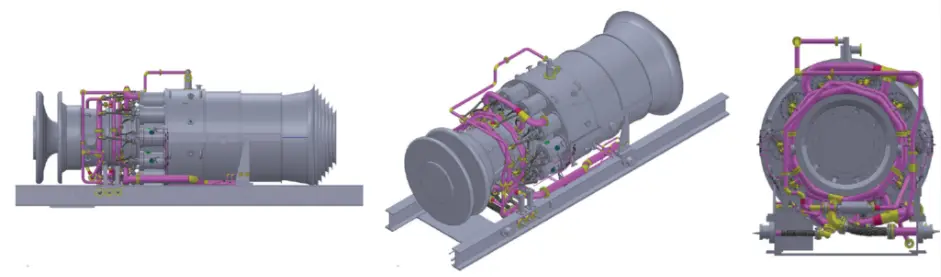
TTS’ Midstream Division’s customer undertook a strategic initiative to modernize pipeline gas transmission assets by upgrading the control systems of three Siemens / Rolls Royce Avon model 1533-76G gas turbines. This variant entered industrial service worldwide in the late 1960s, and was derived from the original Avon engine developed in the 1950’s. These engines remain critical to pipeline compression operations, each delivering approximately 13,900 BHP to drive centrifugal compressors.
TTS Midstream engineered and implemented a unified, Rockwell Automation – Process Automation Controller (PAC) -based control architecture that consolidates governor, sequencer, and surge control functions; relocates control panels into the engine building using classified‑area components; and modernizes instrumentation and fuel control valves. The application program improves reliability, maintainability, and centralized visibility while aligning with fleet standards and providing unlocked, editable code for sustainment by the customer’s controls division.
1. Background and Objectives
The Avon 1533‑76G is a proven aeroderivative gas turbine with decades of service in pipeline compression. Over time, incremental control upgrades resulted in a mixed environment of OEM relay logic and legacy Programmable Logic Controller (PLC) patches. This fragmentation posed challenges: inconsistent troubleshooting approaches, limited diagnostics, and difficulties integrating station‑level control and enterprise monitoring. The customer’s modernization strategy set clear objectives for this project:
- Reliability: Reduce unplanned downtime via robust control logic, improved instrumentation, and integrated surge protection.
- Maintainability: Provide unlocked, well‑documented PAC code enabling in‑house maintenance and future enhancements.
- Operational Visibility: Enhance data availability and standard interfaces to central operations for monitoring and decision support.
- Fleet Standardization: Align hardware and software with corporate standards to streamline spares, training, and support.
Project Scope at a Glance
- Three Avon model 1533‑76G gas turbines (each ~13,900 BHP) driving centrifugal compressors.
- Consolidation of governor, sequencer, and surge control into a single Rockwell Automation PAC platform.
- Control panel relocation into the engine building with hazardous‑area rated components.
- Instrumentation upgrades using Rosemount sensors and manifolds.
- Fuel system upgrades using Continental Controls Corp. (CCC) gas fuel valves, with mechanical design for piping adaptation.
2. Technical Approach and Design
2.1 Unified PAC Architecture
TTS integrated the customer-provided go-by design into a single Programmable Automation Controller (PAC) architecture to host all core turbine control functions. The architecture replaces disparate relay logic and legacy PLC programs with a modular, standards‑compliant application.
Key characteristics include:
- Segmented function logic for governor, sequencer, surge control, protection, and diagnostics.
- Clear visibility for start‑up, run, and shutdown sequences with interlocks and permissives.
- Parameterized control loops with documented ranges and tuning capability to support commissioning and sustainment.
- Unlocked, commented (self-documenting) code to support long‑term maintainability and knowledge transfer.
2.2 Hazardous‑Area Panel Relocation
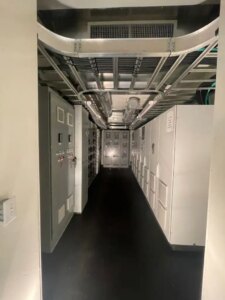
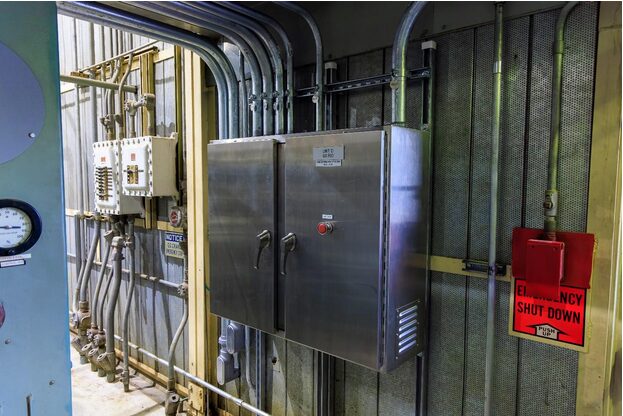
To improve signal integrity and reduce wiring complexity, control panels were relocated into the engine building. The classified environment required the selection of hazardous‑area rated components, enclosures, and wiring practices. Design reviews verified compliance with site classification and ensured compatibility with station electrical standards.

2.3 Instrumentation and Fuel System Modernization
Instrumentation upgrades utilized Rosemount sensors and manifolds for critical measurements, supporting higher accuracy and reliability. Fuel system improvements incorporated Continental Controls Corporation (CCC) AGV50 model 2” gas fuel valves. TTS provided mechanical design for the installation and adaptation of the new valves to existing piping, addressing envelope, mounting, and alignment constraints.
2.4 Integration with Station Controls
The turbine controls were integrated with station‑level systems and electrical/controls wiring relocations supplied by other vendors. Interfaces were standardized to simplify data exchange and alarm handling across the station and enterprise layers.


3. Collaboration and Knowledge Transfer
3.1 Partnership with Sulzer Turbo Services
TTS and Sulzer Turbo Services have a longstanding collaboration on gas turbine projects worldwide. For the Avon platform, Sulzer’s recent expansion into the aeroderivative market provided additional opportunities for joint delivery. Under a cooperation agreement, TTS manufactures Avon control systems for Sulzer projects, while Sulzer contributes technical support and market channel access.
3.2 Logic Development Support
Sulzer supported TTS by sharing go‑by software from previously completed Avon projects and advising on fuel governing and protections specific to the Avon turbine. This accelerated logic development and reduced risk during commissioning.
4. Project Execution
4.1 Compressed Timeline and Design Reviews
The project proceeded under a compressed schedule and required multiple formal design reviews with the customer’s team. Feedback led to several design changes and scope additions, all incorporated through controlled revisions and issue tracking.
4.2 Multi‑Vendor Coordination
TTS coordinated with vendors delivering station controls and electrical/controls wiring relocations. Early interface definition and shared milestones helped mitigate integration risks.
4.3 Site‑Specific Commissioning
During installation and commissioning, TTS worked closely with local operations to tailor logic and setpoints to site‑specific design and operating practices. Iterative tuning and acceptance testing ensured seamless handover.
5. Outcomes and Benefits
5.1 Technical Outcomes
- Consolidated control architecture improves system reliability and reduces failure points.
- Enhanced instrumentation supports better diagnostics and predictive maintenance.
- Upgraded fuel control improves stability and response across operating ranges.
- Standardized interfaces enable clearer alarm management and data visibility.
5.2 Operational Benefits
- Reduced troubleshooting time through improved system diagnostic tools, and unified logic and documentation.
- Improved maintainability via unlocked, editable code and standardized components.
- Streamlined spares management aligned with fleet standards.
- Increased confidence among station operators through collaborative commissioning.
5.3 Business Impact
The retrofit strengthens the customer’s modernization program by delivering tangible reliability and sustainment improvements on critical compression assets. Standardization and maintainability reduce lifecycle costs and support scalability across the fleet.
5.4 Lessons Learned
- Early alignment on hazardous‑area requirements simplifies panel relocation decisions.
- Sharing reference logic accelerates development while preserving site‑specific customization.
- Interface definition and milestone synchronization are essential when multiple vendors contribute critical scope.
- Agile design reviews help absorb late‑stage changes without compromising schedule integrity.
6. Conclusion
The customer’s Avon Gas Turbine Control Retrofit demonstrates how targeted modernization of legacy assets can deliver outsized operational benefits. By unifying control functions on a single PLC platform, upgrading instrumentation and fuel systems, and collaborating effectively across stakeholders, TTS delivered a robust solution that enhances reliability, maintainability, and visibility. The approach sets a repeatable pattern for similar upgrades across midstream compression fleets.
Appendix A: Scope Summary
- Assets: Three Rolls Royce Avon 1533‑76G turbines (~13,900 BHP each).
- Controls: Single Rockwell Automation PAC hosting governor, sequencer, surge control, protections, and diagnostics.
- Panels: Relocated into engine building with hazardous‑area rated components.
- Instrumentation: Rosemount sensors and manifolds.
- Fuel System: CCC gas fuel valves with mechanical design for piping adaptation.
- Deliverables: Control cabinets, PAC hardware, terminal blocks, power supplies, documentation, unlocked code.
Appendix B: Stakeholders and Roles
- The customer’s: Asset owner, operations leadership, design review authority.
- TTS: Controls system design, panel supply, instrumentation upgrades, mechanical integration of fuel valves, commissioning.
- Sulzer Turbo Services: Technical guidance, reference logic, cooperation agreement partner for Avon controls manufacture.
- CCC Supplier of Gas Turbine Fuel Control Valves.
About TTS
TTS Energy Services is a global leader in gas turbine engineering, with decades of experience serving the power industry. Headquartered in Orlando, Florida, with a major operations center in Houston, Texas, TTS provides a wide range of services to the power generation and midstream natural gas industries. From control system modernization and turbine installation to upgrades, repairs, commissioning, field services, and parts—TTS brings industry-best practices and a commitment to excellence to every project.